
LinkedIn Isn't Cringe. You've Just Been Watching Adults Use It Wrong.
Four hundred "Congratulations!" a year, and roughly four of them are real.
"I'm humbled to share," followed immediately by something not remotely humbling. A guy describing his layoff as a journey and then asking you to agree in the comments. A stock photo of two hands shaking, posted by someone whose job has nothing to do with hands, or shaking.
That's what you've seen. That's what everybody means when they say LinkedIn is cringe.
But that's not LinkedIn. That's a small group of adults performing for other adults in the one corner of the site nobody is required to visit. Judging LinkedIn by its feed is like judging a school by its morning announcements.
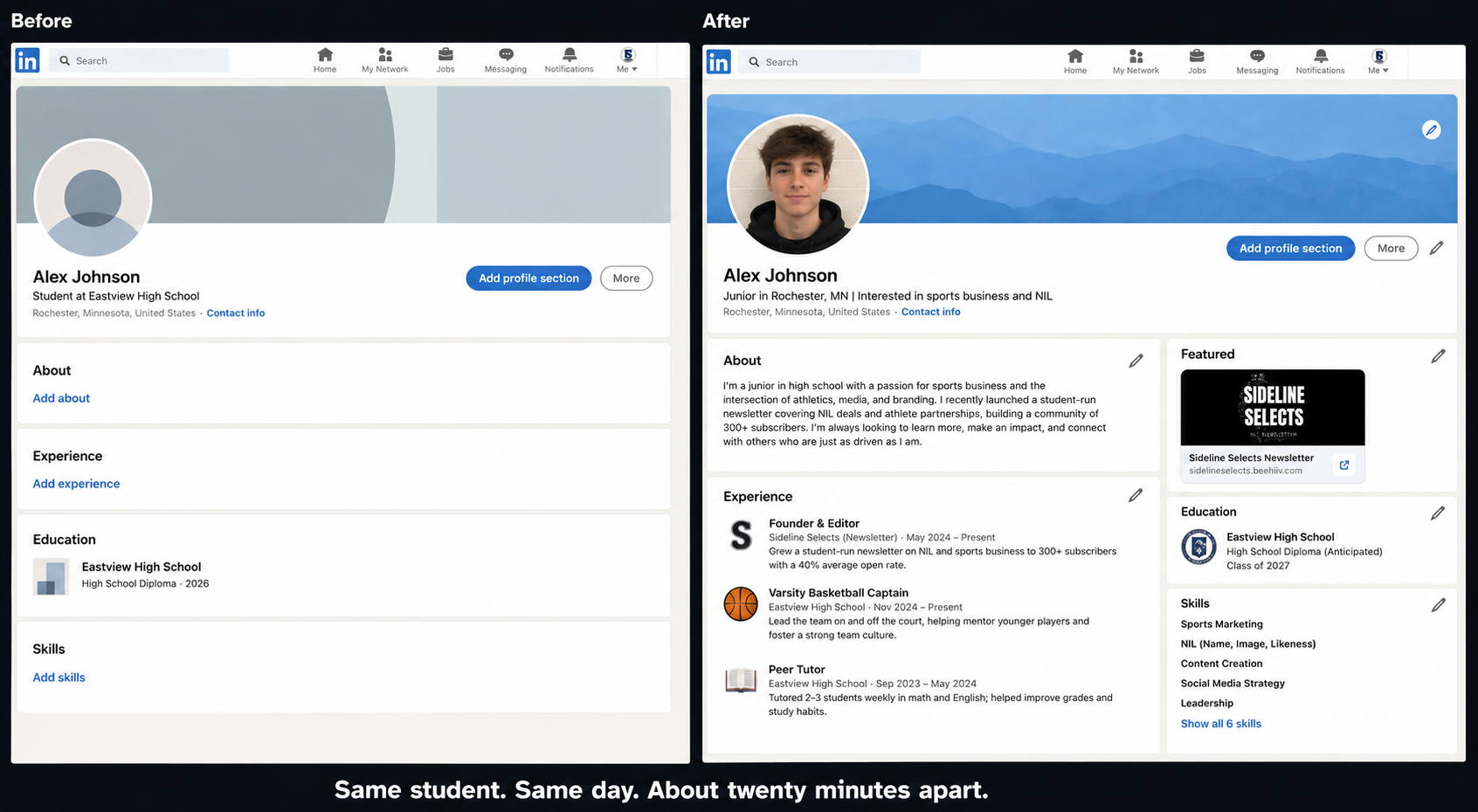
The actual product is the profile. And the profile is one of the highest-leverage twenty minutes you'll spend on the internet this year.
LinkedIn Looksmaxxing — Breakout Session 3, Beyond Now Summit LA "[One line on why the profile matters more than the feed.]" — [Name], [Title]
So is LinkedIn cringe or not?
No. The feed can be. The profile isn't, and the profile is the part that works for you.
You already know how to run a curated page. You've been doing it since you were twelve. Instagram is the four best minutes of someone's month, presented as their life, and you read it correctly without anyone teaching you.
LinkedIn is that same instinct, except the audience is people who can hire you, admit you, or answer your email. Same skill. Higher stakes. Fewer filters.
Once you see it that way, the cringe disappears, because you stop trying to sound like the "humbled to share" guy and start doing the thing he's badly imitating.
Why does a 16-year-old need one?
Three reasons: you become findable, cold outreach starts working, and everything you do now compounds.
You're findable
When an adult you emailed looks you up, LinkedIn is what comes up. Not your Instagram. Not your TikTok.
You get to decide what the first result is instead of leaving it to chance. Right now, for most students, the first result is nothing at all — and a plain, honest profile beats nothing every single time.
Cold outreach starts working
A message from a real photo and a filled-out profile gets answered. A blank one doesn't.
Everyone checks. You send the message, they look you up, and they decide in about two seconds whether you're a real person who did something or an empty account. That two seconds is the entire game, and you can win it in advance.
Everything compounds
Every project, program, job, and internship you log at 16 is still there when you're 22.
Nobody can rebuild this later. At 22 you will not remember the dates, the titles, or what you actually did in the summer of tenth grade. Writing it down takes two minutes now. Reconstructing it from memory in six years is impossible.
Do you have to post?
No — and that's the point people miss. LinkedIn works as a document. The feed is optional.
Posting isn't the cringe. Posting with nothing behind it is the cringe. "Thrilled to announce" is embarrassing because it's an announcement about nothing.
So the rule is simple: post when something real happened. You launched the store. You finished the season. You shipped the app. You got the internship. Link it and move on.
If you've got nothing, say nothing. Silence beats filler by a wide margin, and no one in history has been hired off a carousel about lessons learned.
How Do I Use Linkedin As a High Schooler?
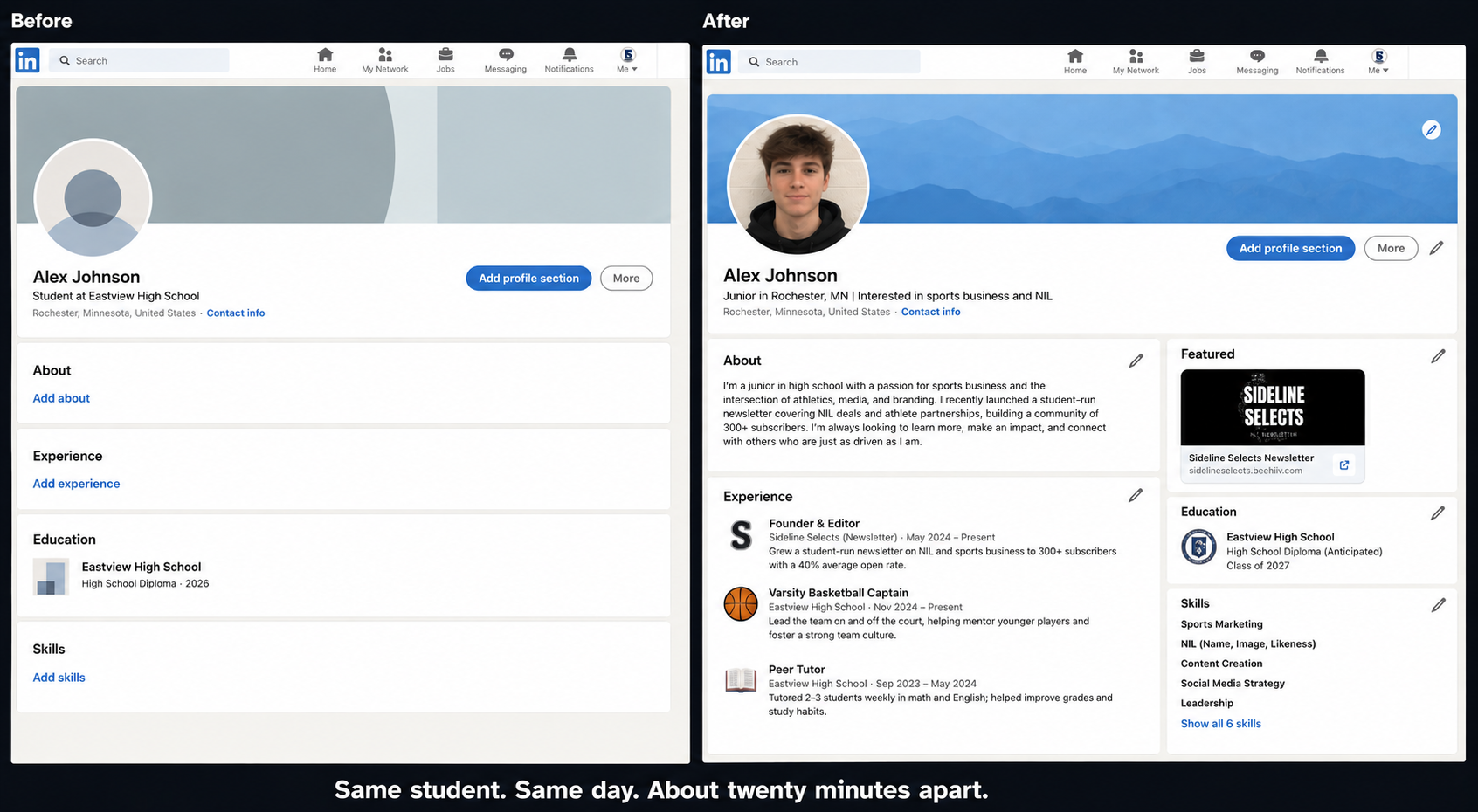
A clean real photo, a headline that says what you're doing, a short About in your own voice, an Experience section built from projects, and one link to something you actually made.
Photo
Phone camera, plain wall, decent light, looking at the lens. It doesn't need to be a professional headshot — it needs to be in that neighborhood. Clean, clear, recognizably you.
Not a suit. Not a cropped group photo with a stranger's shoulder still in frame.
Headline
Say who you are and what you're doing.
Sophomore in NYC | Interested in sports business and NIL
It appears next to your name everywhere on the site, so it works harder than anything else on the page. The default — "Student at [Your] High School" — is what everyone has and says nothing about anyone.
About
Three or four sentences, first person. What you're into, one thing you've made, one thing you want to learn.
Delete the word "aspiring." You're either doing it or you're not, and "aspiring" tells a reader which one.
This should not be your full life story.
Experience
If you've done anything significant it counts
[QUOTE — LINKEDIN LOOKSMAXXING SESSION] "You do not have to work for some massive company to have Linkedin experience. Just be able to speak about why everything on your linkedin is significant and be able to expand on each point with specifics,"
- A project you finished
- Tutoring
- Captain of a team
- Running a club
- A summer program
- Any real job you've had
That last one includes retail, food service, lifeguarding, and camp counselor. Students are strangely embarrassed by these and shouldn't be. A real job you showed up to at sixteen says more about you than an invented title ever will.
Two lines per entry: what it was, and one specific result.
Featured
Link the actual thing — the store, the channel, the deck, the site, the video. A real link beats three paragraphs describing a link.
Education
Your high school and graduation year. Any summer or pre-college program goes here too.
Skills
Five to ten. Only the ones you could defend if someone asked a follow-up question.
What should you not do?
Don't inflate titles, don't post to post, don't collect strangers, don't lie.
Inflated titles. "CEO" of a company with no customers. Adults clock it instantly, and it costs you the credibility the rest of the profile just earned.
Posting to post. Every post needs a reason that exists outside of you wanting to post.
Connection farming. A thousand connections you've never spoken to isn't a network. It's a number.
Lying. This is a permanent, searchable, public document with your name on it.
When should you start?
Now. It takes fifteen or twenty minutes and you don't need a job to do it.
You need a photo, a headline, one honest sentence, and fifteen minutes.
Add to it whenever something happens.
That's not cringe. That's just a good file on yourself that other people can read.